

What is a “Domestic Violence Protection Order”?
A Domestic Violence Protection Order (DVPO) is the official legal name for what many refer to as a restraining order. It is tied to harm or a threat of harm against someone you have or had a personal relationship with.
It is extremely important to deal with a DVPO as soon as you discover one has been entered against you because a DVPO can affect many of your rights. It is best to consult with an experienced criminal defense attorney to obtain advice about your options and come up with a plan to aid you in protecting yourself.
A DVPO is rarely a stand-alone matter. It usually arises in connection with another case, such as a criminal domestic violence charge, divorce, or other family law disputes.
At Cascade Lawyers, we have defended clients in hundreds of DVPO proceeding. If a protection order has been entered against you, please contact us and we can explain the process and begin defending you.
Why You Should Act Immediately
DVPOs are serious and are not something you should fight alone. Many of your freedoms are immediately at risk.
Housing and Exclusion from Your Own Home
After a DVPO petition is filed, courts often issue a temporary order that compels one party to leave the shared home immediately. The respondent (the person named in the order) may be barred from returning to their own home. This often triggers a housing emergency because you will likely have zero warning and no time to find new place to live.
This urgency should not be underestimated. In many cases, you cannot remain in your home while the DVPO is pending.
Loss of Gun Rights & Firearm Removal
If a DVPO is entered, you may be forced to surrender your firearms. Washington law allows (and sometimes requires) courts to order the immediate surrender of firearms, other dangerous weapons, and your concealed pistol license.
In certain conditions, the court must prohibit access, possession, purchase, or receipt of firearms.
A criminal domestic violence conviction or certain misdemeanors can also lead to permanent loss of firearm rights.
The Domestic Violence Protection Order Timeline in Washington
The timeline is short. Everything happens fast. The full process can conclude in about one month.
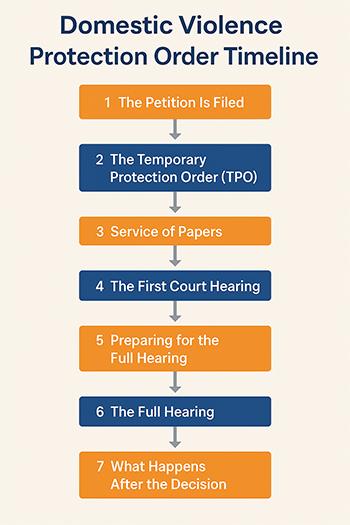
1. The Petition Is Filed
The process starts when a petitioner (the person seeking protection) files a petition for a protection order in Superior Court or District Court. The judge reviews the petition either the same day or the next judicial day. If the judge believes immediate protection is needed, they will issue a Temporary Protection Order (TPO) right away. This is called an “ex parte” order because it is issued without notice to the other side.
2. The Temporary Protection Order
If granted, the TPO can include immediate restrictions such as:
- No contact with the petitioner.
- No entry into the petitioner’s home, work, or school.
- In some cases, removal from the shared family home.
- Firearm surrender or prohibition, depending on the judge’s findings.
The TPO usually lasts up to 14 days. It remains in effect until the full hearing, unless the court extends it for good cause (for example, if the respondent hasn’t been served yet).
3. Service of Papers
The respondent must be served with the petition, the TPO (if granted) and the notice of hearing, which sets the date of the hearing. Service must be done by law enforcement or a process server. Once the respondent has been served, the temporary protection order is enforceable. Anything ordered by the judge on the TPO, whether you agree with it or not, is what you are required to follow.
4. The First Court Hearing
The first court date is usually set within 14 days of filing. At this hearing, both sides can appear. The judge reviews whether the temporary order should continue, be modified, or be dismissed.
If the respondent requests time to hire a lawyer, the judge usually grants a continuance (commonly 2–3 weeks). During that extension, the temporary order remains in effect.
This is when many people realize how serious the restrictions are since they may be unable to return home or contact family until the next hearing.
5. Preparing for the Full Hearing
Between the first and final hearing, both parties can submit written declarations, witness statements, and evidence supporting their version of events, such as text messages, emails, and other communications.
This is the period when defense attorneys do most of the work, such as gathering evidence, creating exhibits, writing responses, and preparing arguments.
6. The Full Hearing
The full hearing usually occurs two to four weeks after the first appearance (depending on continuances, service issues, and court scheduling).
At this hearing, both sides may present evidence and arguments. The judge may question each side or rely on written declarations. A decision is made quickly, often on the same day as the hearing.
If the court grants a full protection order, it generally lasts at least one year.
7. What Happens After the Decision
If a full order is granted, the respondent must comply immediately. Firearm surrender (if ordered) is monitored through compliance hearings. The order is entered into law enforcement databases.
If the order is denied or expires, the respondent can return home (unless other criminal or family court orders still apply).
What the Lawyer Does For a DVPO
In addition to explaining every step of the process, an experienced criminal defense lawyer will:
- Collect, organize, and analyze all evidence (texts, emails, photos)
- Obtain statements called declarations from friends, family, and all witnesses in opposition of the order
- Prepare a response and exhibits to oppose or limit the order
- Handle the hearing so the client likely does not have to speak
- Argue to the judge whether a full order should be issued
Key Terms & Documents You’ll See
- Petitioner = the person requesting protection
- Respondent = the person the order is against
- Temporary Protection Order / Ex Parte Order = an initial order granted without notifying respondent, to protect immediate safety
- Full Order / Final Order = the longer lasting order issued after a hearing
- Notice / Summons = the court sends these to you via mail or law enforcement to tell you when to appear
- Order to Surrender Weapons = part of an order forcing surrender of firearms, dangerous weapons, or a concealed pistol license
Risks if You Don’t Respond or Defend
If you don’t respond to the Summons, the Court is likely to enter a protection order by default. You will lose your right to contest the terms of the DVPO. Gun removal or prohibition may be ordered without your input, and you may be barred from your home or shared property or barred from contacting the Petitioner.
If you don’t respond or defend yourself, later efforts to undo or reduce the scope of the DVPO are much more difficult. If you think a DVPO is being used as leverage and not being used properly, you must respond and challenge the protection order.
Proven DVPO Defense Skills at Your Disposal
At Cascade Lawyers, we have defended hundreds of clients in DVPO proceedings. We understand how to oppose protection orders and how to build your case. We have proven success throughout Washington State.
Start Building Your Defense
Cascade Lawyers offers free consultations, and we can begin addressing your legal needs immediately. Call 206-970-3030 or send an email to discuss your case with a skilled Seattle DVPO defense lawyer. The firm represents clients in Thurston County, Kitsap County, Pierce County, Snohomish County, King County and throughout the state.
FAQs
What is a Domestic Violence Protection Order (DVPO)?
A DVPO is a civil court order that protects someone who says they have been abused or threatened by a family member, partner, or roommate. It can restrict contact, require someone to leave a shared home, and in some cases, order them to give up firearms.
How is a DVPO different from a “restraining order”?
People often say, “restraining order,” but Washington law uses the term “protection order.” A DVPO is a specific type of protection order for domestic violence situations.
What happens after I get served with a DVPO?
Once served, the order takes effect immediately. You must follow it exactly, even if you disagree with it. You’ll also receive a court date, usually within 14 days, for a hearing to decide if the order should continue. You should consult with an attorney right away.
Can a temporary DVPO force me to move out of my home?
Yes. Judges can issue a temporary order that requires you to leave the shared home right away. This can happen before a full hearing if the court believes immediate protection is needed.
Will I lose my gun rights if a DVPO is filed against me?
It depends. If the court orders firearm surrender, you must turn in your guns and concealed pistol license while the order is active. If you are later convicted of a domestic violence offense, that can cause a permanent loss of gun rights.
How long does a protection order last?
A temporary order usually lasts up to 14 days, or until the next hearing. A full protection order, if granted, typically lasts at least one year. In some cases, the court can renew it or make it permanent.
What should I do if I’m served with DVPO paperwork?
Read everything carefully. Do not contact the person who filed it. Comply with the order. Gather evidence like texts, emails, or witness statements. Then, call a lawyer right away. You have very little time to respond.
What happens if I violate a DVPO?
Violating a DVPO is a crime in Washington. Police can arrest you immediately, and you may face jail, fines, or new criminal charges. Even accidental contact can count as a violation, so take the order seriously. Many orders include a prohibition of third-party contact, so you cannot have a friend contact the petitioner on your behalf. Doing so would be a violation of the order.